If you care about what goes into your body, finding the cleanest protein foods in 2026 has become both more important and more complicated than ever. Protein is everywhere — on shelves, in supplements, in ready-to-eat meals — but the word “clean” gets used so loosely that it has nearly lost its meaning. Microplastics contamination in packaged foods, undisclosed additives, and vague sourcing claims have made a lot of health-conscious eaters justifiably skeptical.
This guide breaks down exactly what separates a truly clean protein source from the noise: what to look for on labels, what third-party testing actually tells you, which red flags to avoid, and why a new category of rigorously tested, whole-food protein is emerging as the benchmark for 2026.
The Cleanest Protein Foods: Why the Category Needs a Reset
For years, “clean eating” meant avoiding processed junk — reading ingredient lists, watching for seed oils, cutting artificial sweeteners. That was a good start. But in 2026, the standards have shifted.
The new frontier of food purity isn’t just about what’s listed on the label. It’s about what is not required to be listed: microplastics, nanoplastics, trace chemical residues from packaging, and cross-contamination from processing equipment.
Studies published through 2024 and 2025 confirmed what food scientists had suspected: microplastics have found their way into a significant percentage of commercially packaged protein products. That includes popular protein powders, pre-packaged meats, and ready-to-eat snacks. The contamination typically comes from packaging materials, processing lines, and storage environments — not from the food itself. Which means a food can have a perfectly clean ingredient list and still carry a measurable microplastics load.
This is why a single standard now defines what the cleanest protein foods actually are: third-party testing for microplastics, on the final packaged product.
Most brands don’t do this. Third-party microplastics testing is expensive, requires specialized labs, and surfaces data brands might not want public. The few that do it — and publish the results — are operating at a different level of transparency.
The market has responded. Brands that can demonstrate clean protein through verifiable third-party testing are commanding premium prices and building dedicated followings among fitness communities, biohackers, and health-conscious families. Im’peccable Chicken is the clearest example of this trend: a ready-to-eat chicken brand that went through the process of independent microplastics testing and positioned that testing as the centerpiece of its identity.

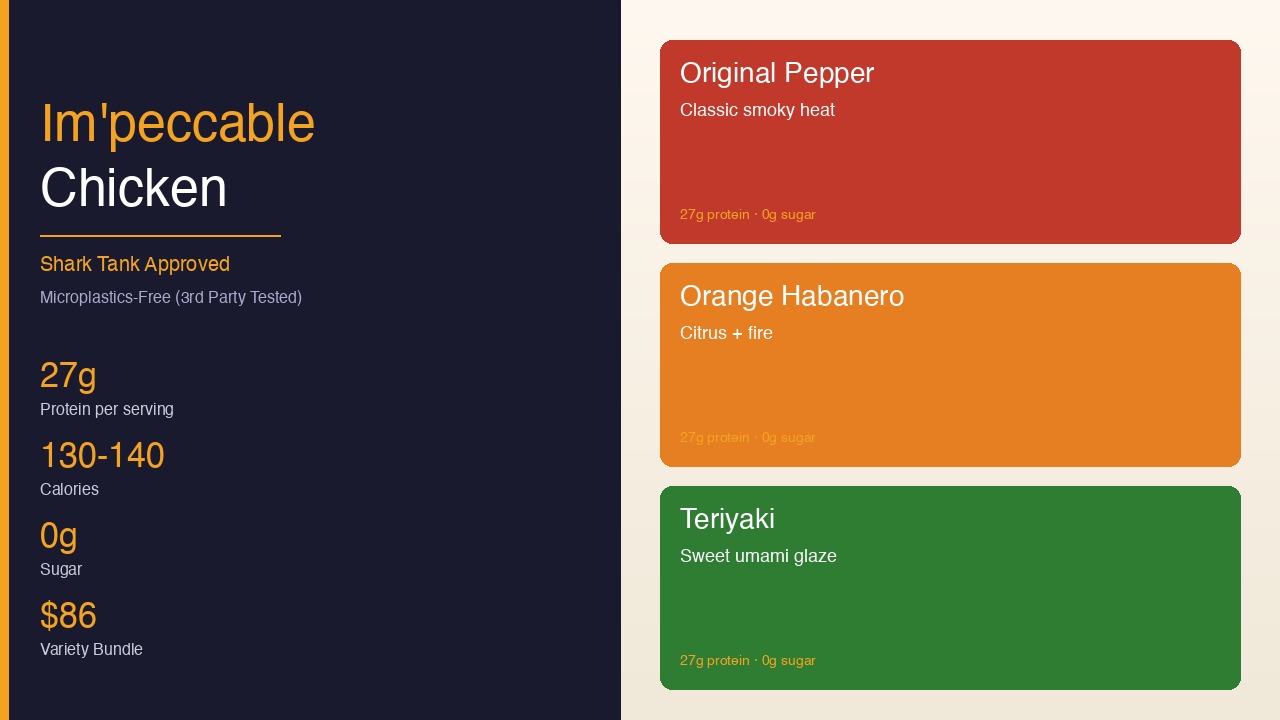
Im’peccable Chicken Variety Bundle – 3 flavors (Original Pepper, Orange Habanero, Teriyaki), 27g protein, 130-140 cal, 0g sugar. From $86.
What Third-Party Testing Actually Tells You
When a brand says “third-party tested,” that phrase can mean very different things. Third-party testing for purity is not the same as third-party testing for nutrition facts, or third-party testing for sports supplement certifications.
Here’s how to evaluate what a brand’s testing claim actually covers:
Nutritional third-party testing — The most common type. A lab verifies that macros, calories, and ingredient weights match what’s printed on the label. This is useful but does not address contamination.
Sports certification testing (NSF, Informed Sport, etc.) — Checks for banned substances on athletic doping lists. Again, no bearing on microplastics or environmental contamination.
Microplastics-specific testing — This is the category that matters for clean protein in 2026. Labs use pyrolysis-GC/MS or similar techniques to detect the presence and concentration of plastic particles in the final product. Very few food brands have commissioned this testing.
When a protein source has been third-party tested specifically for microplastics contamination and cleared, it sets the bar that other products should be held to. It’s what distinguishes a brand making a marketing claim from one making a verifiable scientific claim.
Im’peccable Chicken’s microplastics-free certification falls into this category. The brand has been independently tested, not just self-certified. That’s the distinction that matters when you’re deciding what cleanest protein foods actually deserve the label in 2026.
Whole-Food Protein vs. Processed Protein: The Quality Gap
One of the fastest ways to identify a genuinely clean protein source is to look at how processed it is. The protein delivery mechanism matters enormously — not just for purity, but for bioavailability and how your body uses it.
Whole-food protein sources include chicken breast, eggs, fish, beef, and legumes. These are the original format — minimally processed, recognizable, complete amino acid profiles. The challenge with whole-food proteins for busy people is preparation time and consistency.
Minimally processed ready proteins — pre-cooked chicken that uses the whole muscle with minimal additives — sit at the ideal intersection of convenience and cleanliness. The key is “minimal processing” meaning the protein structure stays intact and the ingredient list is short.
Heavily processed protein products — protein powders, protein bars, extruded snacks with isolated protein concentrates — involve multiple processing steps, each of which introduces opportunity for contamination and degradation of nutritional value. Many also rely on packaging and manufacturing environments where microplastics exposure is highest.
For fitness-focused consumers looking at cleanest protein foods, the hierarchy looks like this:
- Fresh whole-food protein (ideal, but requires cooking)
- Rigorously tested ready-to-eat whole-food protein (the category Im’peccable Chicken occupies)
- Clean-label protein powders with verified testing
- Standard protein bars and processed snacks (most exposure risk)
What to Avoid: Red Flags on Protein Product Labels
Not all protein marketing is honest. Here are the most common red flags in the cleanest protein foods category:
Vague sourcing language — phrases like “premium quality protein” or “carefully selected” without any specifics about where the animal protein comes from, how it’s raised, or how it’s processed.
Proprietary blends — in the supplement space especially, this hides the actual quantity of each ingredient. In food, analogous opacity about seasoning mixes or processing aids is worth noting.
No third-party certification of any kind — a brand selling “clean” protein without any independent verification is asking you to trust their own quality control.
Packaging claims that exceed what’s testable — terms like “100% natural” or “pure” that aren’t backed by any certification standard are marketing language, not nutritional claims.
Long ingredient lists on simple products — if a product is essentially chicken, it should list chicken and perhaps seasoning. When you see a list of 15 items for something sold as clean protein, that is not a clean protein product.
No information about manufacturing environment — cross-contamination from packaging equipment is a primary microplastics vector. Brands that have addressed this will mention it; brands that haven’t will stay quiet.
The Macro Profile That Makes Clean Protein Worth It
Choosing a clean protein source isn’t just about what’s absent — it’s about what’s there. A strong macro profile is what makes the premium price point defensible for health-focused consumers.
Im’peccable Chicken delivers numbers that align with the targets most fitness nutrition frameworks use:
- 27g protein per serving — significant for muscle protein synthesis, hitting the range most research suggests is optimal per meal for maximally stimulating MPS in adults
- 130-140 calories per serving — lean, low-calorie protein that fits cutting phases, maintenance, and recomposition
- 0g sugar — zero sugar means no insulin spike from the protein source itself, which matters for metabolic health and body composition
- Clean macros — the calorie composition comes almost entirely from protein and minimal fat, with no empty carbohydrate filler
This profile puts it squarely in the “complete lean protein” category — the most desirable slot for anyone doing structured nutrition for fitness, longevity, or metabolic health.
For more on how to build these cleanest protein foods into a practical weekly system, see our guide on how to meal prep high protein chicken the clean way.
Shark Tank Credibility and What It Signals
The appearance of Im’peccable Chicken on Shark Tank isn’t just a marketing footnote — it signals something meaningful about the brand’s claims.
Shark Tank investors conduct their own due diligence. When they invest in or endorse a food brand with a specific health claim (microplastics-free, in this case), they are staking their reputation on the validity of that claim. The vetting process is adversarial: investors are incentivized to find holes, not to rubber-stamp promises.
That doesn’t mean Shark Tank approval is equivalent to a clinical study. But it does mean the brand’s foundational claims were examined by people with financial incentive to disbelieve them. In a category where green-washing is pervasive, that level of external scrutiny carries weight.
2026 Protein Landscape: What the Cleanest Brands Are Doing Differently
The gap between genuinely clean protein brands and conventionally marketed ones is widening. Here’s what separates the leaders in the cleanest protein foods category heading into the second half of 2026:
Radical transparency on testing — publishing actual test results, not just claiming “tested.” The move is toward consumer-accessible lab reports, not just certification logos.
Packaging innovation — leading brands are transitioning away from flexible plastics (a primary contamination source) toward glass, aluminum, or novel barrier materials. This is still rare in the ready-to-eat chicken space.
Supply chain specificity — naming the farm, the feed protocol, the processing partner. Vague sourcing is the first thing to disappear from legitimately clean brands.
Nutritional density focus — the cleanest protein foods in 2026 are built around maximizing protein per calorie, not just minimizing bad ingredients. The positive case for the product matters as much as what’s excluded.
Im’peccable Chicken hits four of these four markers: verifiable testing, focused nutritional profile, Shark Tank-verified brand claims, and an origin story that foregrounds transparency about what the product is and isn’t.
How to Shop for the Cleanest Protein Foods in 2026
A practical checklist for evaluating any protein product:
Step 1: Find the testing claim. Is there third-party testing? For what specifically? Where can you access the results?
Step 2: Read the full ingredient list. If it’s a protein that should have three or four ingredients and has fifteen, something is being added that doesn’t need to be there.
Step 3: Evaluate the macro density. Protein-per-calorie ratio should be high. More than 30 calories per gram of protein is a flag that you’re paying for filler.
Step 4: Check the packaging. Flexible single-serve plastic pouches are the highest-risk format for microplastics. Glass and hard plastic containers are lower risk. Know what you’re buying.
Step 5: Cross-reference any “Shark Tank,” “celebrity,” or “clinical” claims. These should be verifiable through public records, not just stated on a product page.
Frequently Asked Questions
What makes a protein food “clean” in 2026?
In 2026, the definition has expanded beyond just “natural ingredients.” Clean protein now means minimal processing, a short verifiable ingredient list, and ideally third-party testing for microplastics contamination on the final packaged product.
Are microplastics really a concern in protein products?
Yes. Research published through 2025 shows microplastics are present in a measurable percentage of packaged protein products. The contamination comes primarily from packaging materials and processing environments, not from the protein source itself.
What is Im’peccable Chicken?
Im’peccable Chicken is a ready-to-eat chicken brand that delivers 27g of protein per serving at 130-140 calories with 0g sugar. The brand was featured on Shark Tank and has been independently third-party tested to be microplastics-free.
How much protein do I need per serving for muscle building?
Research generally suggests 20-40g of high-quality protein per meal to maximally stimulate muscle protein synthesis in adults. Im’peccable Chicken’s 27g per serving sits comfortably in this range.
Where can I buy Im’peccable Chicken?
The Variety Bundle (Original Pepper, Orange Habanero, Teriyaki) is available at impeccablechicken.shop starting at $86, with free shipping on orders over $100.
Is the Variety Bundle worth it?
For a deeper breakdown of the three flavors, the nutritional profile per serving, and whether the price point is justified, read our Im’peccable Chicken review.
Third-party testing for microplastics is the new benchmark for clean protein in 2026.
The cleanest protein foods of 2026 are defined by standards that didn’t exist five years ago. Microplastics testing, transparent supply chains, and verifiable third-party data are the new baseline — not bonus features. Brands that meet these standards represent a legitimate category upgrade, and the price premium they command reflects real investment in consumer safety.
If you’re building a nutrition plan around clean, high-protein foods, the practical starting point is: what has actually been tested, and by whom? Im’peccable Chicken’s Variety Bundle is one of the clearest answers to that question in the ready-to-eat protein space right now.
Ready to try the Variety Bundle? Shop Im’peccable Chicken at impeccablechicken.shop — free shipping over $100.