The functional beverage market is full of products that gesture at science without actually engaging with it. Ingredient names get dropped onto labels alongside meaningless dosages, and consumers are left guessing whether the product contains anything real.
Nello Supercalm is notably different in this respect. The formula is built around a small number of well-studied compounds, each present at dosages that align with clinical research rather than label-decoration quantities. This post breaks down each Nello Supercalm ingredient, what the science actually shows, and why the formula is built the way it is.
KSM-66 Ashwagandha: The Cornerstone Ingredient
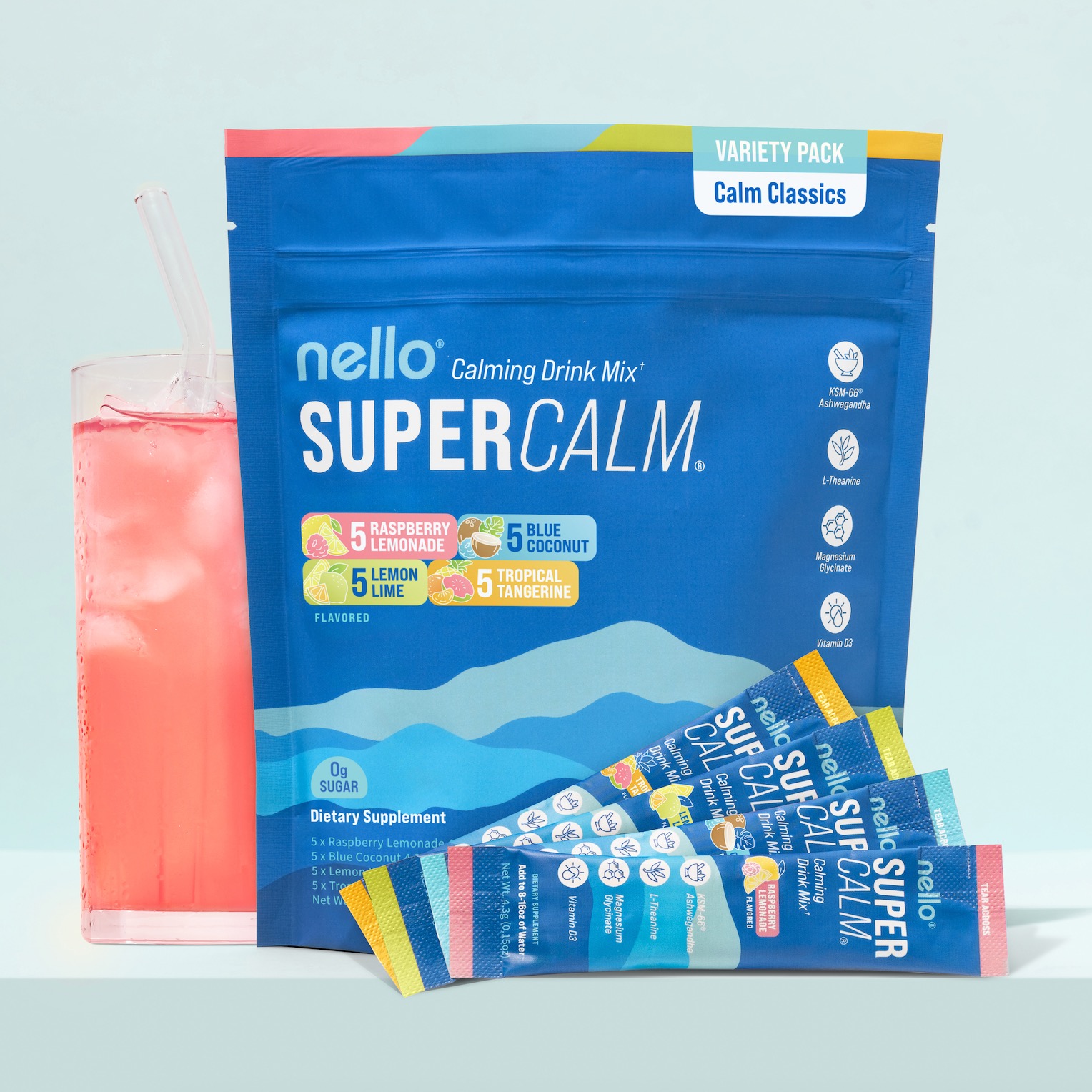
Not all ashwagandha is the same. The difference between KSM-66 and generic ashwagandha root powder is the difference between a standardized pharmaceutical-grade extract and a commodity ingredient - and that difference matters enormously when evaluating any supplement’s effectiveness.
KSM-66 is a patented, full-spectrum ashwagandha root extract produced by Ixoreal Biomed. “Full-spectrum” means it preserves the natural balance of withanolides (the active compounds) as they occur in the root, rather than isolating a single fraction. It is the most clinically studied form of ashwagandha available, with a dedicated body of human trials behind it.
The Chandrasekhar 2012 Study
The most frequently cited research on KSM-66 is the Chandrasekhar et al. 2012 randomized, double-blind, placebo-controlled trial published in the Indian Journal of Psychological Medicine. The study gave 64 adults with a history of chronic stress either 300 mg of KSM-66 twice daily (600 mg total) or a placebo for 60 days.
Key findings in the KSM-66 group:
– 27.9% reduction in serum cortisol levels compared to baseline
– Significantly lower scores on the Perceived Stress Scale (PSS)
– Reduced scores on the General Health Questionnaire (GHQ-28)
– Improvements in sleep quality
This is a meaningful result in a population that is difficult to study - chronic stress is subjective, and placebo effects in this category tend to be strong. The 27.9% cortisol reduction is a biological marker that goes beyond self-report, lending the finding extra credibility.
How Ashwagandha Modulates Cortisol
Ashwagandha is classified as an adaptogen - a substance that helps the body regulate its stress response more efficiently without simply suppressing it. The primary mechanism involves the hypothalamic-pituitary-adrenal (HPA) axis, which is the chain of glands and hormones that controls cortisol output.
Under chronic stress, the HPA axis becomes dysregulated: it continues producing cortisol even when the acute stressor has passed, leading to elevated baseline cortisol. Ashwagandha’s withanolides appear to interact with the HPA axis to help normalize this feedback loop, reducing cortisol output to a more appropriate level rather than blocking it entirely.
This is an important distinction. Cortisol is essential - it regulates immune function, metabolism, and the acute stress response. The goal is not zero cortisol; it is appropriate cortisol that rises when needed and falls when the threat passes.
Why the Dose Matters
Many supplements include ashwagandha at doses well below 300 mg per serving. At these levels, the ingredient is effectively decorative - enough to put “ashwagandha” on the label, not enough to replicate the effects seen in clinical trials. The key trial used 600 mg per day, and any formulation claiming clinically meaningful effects should be in that range.
Magnesium Glycinate: The Bioavailability Difference
Magnesium is the second major ingredient in Supercalm, and the specific form - glycinate - is a deliberate choice with meaningful consequences.
Why Form Matters for Magnesium
Magnesium comes in many supplemental forms: oxide, citrate, malate, glycinate, threonate, and others. They are not interchangeable.
Magnesium oxide is the cheapest and most common form in budget supplements. It has poor bioavailability - studies suggest only around 4% of the magnesium is actually absorbed. Most of it passes through the gastrointestinal tract, which is also why magnesium oxide has a pronounced laxative effect at even moderate doses.
Magnesium glycinate (also called magnesium bisglycinate) is magnesium chelated to glycine, an amino acid. This chelation significantly improves absorption and is far gentler on the digestive system. Research suggests it is among the most bioavailable oral forms of magnesium, making it a superior choice for any formulation where you want the magnesium to actually reach tissues and exert its effects.
Magnesium’s Role in Stress and Calm
Magnesium is involved in over 300 enzymatic reactions in the body, and several of its functions are directly relevant to stress regulation:
- Nervous system regulation: Magnesium acts as a natural antagonist to NMDA receptors - the same glutamate receptors that drive excitatory neural activity. Higher magnesium keeps neural excitability in check.
- GABA support: Magnesium supports GABA (gamma-aminobutyric acid) activity, the primary inhibitory neurotransmitter in the brain. Low GABA activity correlates with anxiety and difficulty relaxing.
- HPA axis modulation: Research has found bidirectional relationships between magnesium and cortisol - chronic stress depletes magnesium, and low magnesium amplifies the stress response, creating a reinforcing cycle that magnesium supplementation can help interrupt.
- Muscle relaxation: Magnesium’s role in muscle function extends to the physical tension that accompanies chronic stress - the tight shoulders, jaw clenching, and headaches that people under sustained pressure commonly experience.
Magnesium deficiency is also genuinely common: surveys consistently find that a significant proportion of adults in developed countries do not meet recommended daily intakes through diet alone, partly because modern agricultural practices have reduced magnesium concentrations in soil and thus in food.
L-Theanine: Relaxed Focus Without Sedation
L-theanine is an amino acid found almost exclusively in tea leaves (Camellia sinensis). It is responsible for much of the distinctively smooth, non-jittery quality of green tea’s effect on alertness - a quality that contrasts with pure caffeine, which tends to produce sharper spikes and harder crashes.
Alpha Wave Research
The most interesting area of L-theanine research involves its effects on brain wave patterns. In EEG studies, L-theanine supplementation has been shown to increase alpha wave activity in the brain within 30-40 minutes of ingestion.
Alpha waves (8-12 Hz) are associated with a specific mental state: relaxed, alert, and focused. They are the brain state associated with creative work, meditation, and calm attention. They are reduced by acute stress and anxiety, which shift the brain toward higher-frequency beta wave dominance.
This alpha-wave effect explains the characteristic feeling that users often describe with L-theanine: a mental softening - reduced reactivity, less rumination, maintained focus - without drowsiness or cognitive dulling. It is the mechanism that makes L-theanine especially appropriate for a daytime stress product.
L-Theanine as a GABA Precursor
L-theanine also has indirect effects on GABA - the brain’s main inhibitory neurotransmitter - by influencing the balance of excitatory and inhibitory neurotransmission. While L-theanine does not cross the blood-brain barrier and convert directly to GABA, it modulates the glutamate/GABA balance in ways that support calmer neural activity.
The Caffeine Synergy (and Why Supercalm Skips It)
L-theanine is frequently studied in combination with caffeine, and the pairing does produce genuine cognitive benefits: caffeine’s stimulatory effects are smoothed by theanine’s calming influence. Many pre-workout and focus supplements use this combination.
Nello Supercalm deliberately does not include caffeine. The rationale is sound: cortisol-calming is the goal, and caffeine is a cortisol-elevating compound. Adding caffeine to a cortisol drink would partially work against the formula’s core purpose. L-theanine works just as well without caffeine for the relaxation component, and keeping the formula stimulant-free makes it appropriate for use later in the day without disrupting sleep.
Why No Melatonin?
This is one of the most important formulation decisions Nello made, and it deserves its own explanation.
Melatonin is a hormone produced by the pineal gland that signals the body to initiate sleep. It is genuinely useful for circadian rhythm correction - jet lag, shift work, resetting a disrupted sleep schedule. What it is not useful for is daytime stress management.
Taking melatonin during daylight hours creates real problems:
– It signals the circadian system that it is nighttime, disrupting your internal clock
– It causes drowsiness and impairs reaction time and cognitive performance
– It can cause next-day grogginess, particularly at doses above 1 mg (many products use 5-10 mg)
– Chronic daytime melatonin use may blunt your body’s own melatonin production
Many “calm” and “relaxation” products include melatonin because it reliably causes a subjective sense of relaxation - but at the cost of your ability to function during the day. A product meant to be consumed during waking hours should not contain a sleep hormone.
Supercalm’s calm comes from ashwagandha’s cortisol modulation, magnesium’s nervous system support, and L-theanine’s alpha-wave promotion. These mechanisms produce genuine daytime-appropriate calm: you remain alert, functional, and focused - just less reactive and less burdened by stress.
Third-Party Testing and Quality Standards
The ingredients in Supercalm are only as good as the quality of the specific extracts used and the accuracy of the label claims. Nello undergoes third-party testing to verify both.
Third-party testing matters because supplement manufacturing is not as tightly regulated as pharmaceutical manufacturing. Without independent testing, there is no guarantee that a product contains what the label says, in the amounts stated, free from contaminants like heavy metals or microbial pathogens.
The use of KSM-66 specifically (rather than generic ashwagandha) provides an additional quality layer, since KSM-66 comes with its own standardization and quality control from the ingredient supplier, on top of whatever finished-product testing Nello conducts.
Ingredient Summary
| Ingredient | Form | Primary Mechanism | Onset |
|---|---|---|---|
| Ashwagandha | KSM-66 (patented extract) | HPA axis / cortisol modulation | 2-4 weeks consistent use |
| Magnesium | Glycinate (chelated) | Nervous system, GABA, HPA support | Days to weeks |
| L-Theanine | Free-form amino acid | Alpha wave promotion, GABA balance | 30-40 minutes |
The formula is deliberately lean. Three core ingredients, each with a defined role and clinical support behind it, is a more credible approach than a long list of loosely related herbs added at micro-doses.
Putting It Together
What makes the Nello Supercalm ingredient profile work as a system is the coverage across different time horizons: L-theanine works within the same session, giving you near-term edge smoothing; magnesium works over days as tissue levels normalize; KSM-66 works over weeks as HPA axis regulation improves.
This is consistent with how adaptogens are supposed to be used - as consistent daily support rather than on-demand intervention.
For a broader overview of the product including taste, flavors, and real-world expectations, see our full Nello Supercalm Review. And if you want to build a complete cortisol management strategy around supplement support, read: How to Lower Cortisol Naturally: A 30-Day Stress Reset Plan.