Cortisol has a reputation problem. Often called simply “the stress hormone,” it gets framed as the enemy - something to eliminate. But cortisol is essential: it regulates your immune response, controls inflammation, governs metabolism, and drives the alert, focused state that helps you perform under pressure.
The real problem is chronically elevated cortisol - when the stress response never fully switches off. That state drives a familiar cluster of symptoms: fatigue that sleep does not fix, afternoon energy crashes, persistent cravings for sugar and refined carbs, disrupted sleep, mood instability, and a low-grade anxiety that becomes your baseline.
Learning how to lower cortisol naturally is less about eliminating the hormone and more about restoring its natural rhythm: high in the morning to drive alertness, declining through the day, and low at night to allow deep sleep.
This 30-day plan uses a phased approach - layering in changes week by week to avoid overwhelm and to give each intervention time to produce its effects before the next one is added.
Signs Your Cortisol May Be Chronically Elevated
Before starting a reset, it helps to understand why you’re doing it. Chronically high cortisol typically shows up as a pattern of interconnected symptoms:
Morning / Throughout the Day:
– Waking up exhausted despite adequate sleep
– Difficulty concentrating or persistent mental fog
– Reliance on caffeine to function at all
– Feeling “wired but tired” - mentally wound up but physically depleted
Physical:
– Cravings for high-sugar or high-carbohydrate foods (cortisol drives glucose demand)
– Weight gain concentrated around the midsection
– Frequent illness (chronic cortisol suppresses immune function)
– Digestive issues (cortisol diverts resources away from digestion)
Evening / Night:
– Difficulty falling asleep despite feeling exhausted
– Waking between 2 and 4 AM and being unable to return to sleep
– Racing thoughts at bedtime
If several of these match your experience, a structured cortisol reset is worth attempting.
Common Lifestyle Cortisol Triggers
Cortisol responds to both psychological and physiological stressors. Many people are unknowingly piling on cortisol triggers through habits they think are healthy:
- Skipping meals or aggressive caloric restriction: The body responds to energy deficiency as a threat, triggering cortisol.
- High-intensity exercise every day without recovery: Intense exercise acutely raises cortisol (which is appropriate and adaptive), but training without adequate rest keeps baseline cortisol elevated.
- Caffeine overuse: Caffeine directly stimulates cortisol release. Multiple coffees spaced throughout the day can keep cortisol artificially elevated well into the afternoon.
- Irregular sleep schedules: Cortisol has a tight circadian relationship - consistent wake and sleep times anchor the natural cortisol curve.
- Constant low-level stressors: Email at all hours, news consumption before bed, and persistent background noise all count as stressors even if they feel minor.
Understanding your personal triggers is part of the reset.
Week 1: Anchor Your Sleep
Cortisol follows a circadian rhythm, and that rhythm is anchored by light and sleep timing. A dysregulated sleep schedule produces dysregulated cortisol - full stop. Week 1 addresses the foundation.
What to Do
1. Set a consistent wake time and hold it.
Your body’s cortisol awakening response (CAR) - a sharp spike in cortisol in the 30 minutes after waking - sets the day’s hormonal rhythm. Waking at the same time every day, including weekends, stabilizes this rhythm over 1-2 weeks. This is more impactful than trying to “catch up” on sleep by sleeping in.
2. Get bright light within 30 minutes of waking.
Morning sunlight (or a light therapy lamp in winter) anchors the circadian clock and ensures the cortisol curve peaks at the right time - early morning - so it can naturally decline through the day. Even 10 minutes outside is effective.
3. Move caffeine intake to 90 minutes after waking.
Cortisol is already naturally high when you wake. Consuming caffeine immediately suppresses your body’s own cortisol production while adding artificial cortisol stimulus. Waiting 90 minutes allows the natural cortisol spike to complete before caffeine is added.
4. Create a 30-minute wind-down buffer before bed.
The transition from high-stimulus activity (screens, work, arguments) to sleep is not instantaneous. Blue light suppresses melatonin; high-engagement content keeps the nervous system activated. A simple 30-minute buffer of low-stimulation activity - reading, gentle stretching, dim light - gives the nervous system time to shift into sleep mode.
5. Keep your bedroom cool and dark.
Temperature drop is one of the body’s key sleep-onset signals. A cool room (roughly 65-68°F / 18-20°C) supports faster sleep onset and deeper sleep. Even small amounts of ambient light can suppress melatonin production.
Week 1 Metrics to Track
- What time you wake up (aim for consistency)
- Whether you got morning light
- How many cups of coffee you consumed and when
- How long it took to fall asleep
Week 2: Add Adaptogen Support
With the sleep foundation being established, Week 2 introduces adaptogenic supplement support. This is where cortisol modulation begins from the inside.
Why Now, Not Week 1?
Adaptogens work by helping the body regulate its stress response more efficiently. But they work best on top of a functional foundation - not as a shortcut around disrupted sleep and chaotic daily patterns. Starting with sleep hygiene ensures you are not asking ashwagandha to compensate for factors it cannot fix.
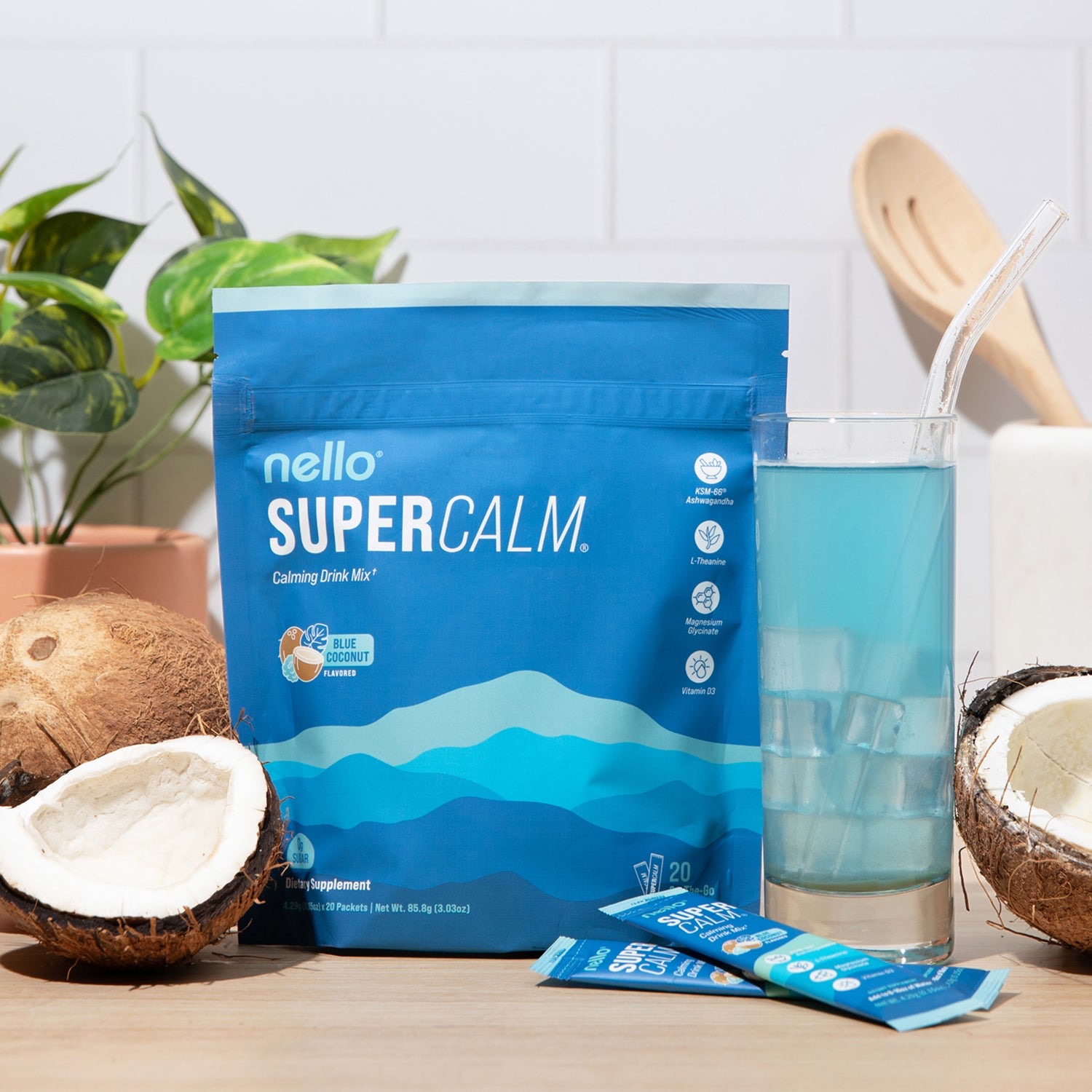
Introducing Nello Supercalm
Nello Supercalm is a powdered drink mix built specifically for daytime cortisol management. Its formula centers on three clinically studied ingredients:
- KSM-66 Ashwagandha: The most-researched form of ashwagandha, shown in a 2012 randomized trial (Chandrasekhar et al.) to produce a 27.9% reduction in serum cortisol over 60 days of consistent use.
- Magnesium Glycinate: A highly bioavailable form of magnesium that supports GABA function and nervous system regulation.
- L-Theanine: An amino acid from green tea that increases alpha brain waves within 30-40 minutes, promoting alert calm without sedation.
Critically, Supercalm contains no melatonin - making it suitable for daytime use without disrupting your circadian rhythm or causing grogginess.
For a detailed breakdown of the science behind each ingredient, see: Nello Supercalm Ingredients: What the Science Actually Says.
How to Use It
Mix one serving of Nello Supercalm into 8-12 oz of cold water. The best timing for most people is mid-morning to early afternoon - after your cortisol awakening response has peaked but before the afternoon, when cortisol naturally dips and stress-driven fatigue often hits hardest.
Additional Adaptogen Practices for Week 2
Alongside supplement support:
- Limit coffee to a maximum of 2 cups before noon. Each cup of coffee triggers a cortisol spike that adds to the day’s total cortisol load.
- Add one stress-decompression practice to your routine. Even 5-10 minutes of deliberate calm - box breathing, a short walk outside, or a simple meditation - activates the parasympathetic nervous system. This does not need to be elaborate. The goal is regular activation of the rest-and-digest state.
- Box breathing technique: Inhale 4 counts, hold 4, exhale 4, hold 4. Repeat 4-6 cycles. This is a clinically backed technique for activating the vagus nerve and shifting from sympathetic (fight-or-flight) to parasympathetic (rest-and-digest) dominance.
Week 3: Time Your Exercise
Exercise is one of the most powerful tools for long-term cortisol regulation - but exercise timing and type matter.
The Exercise-Cortisol Relationship
Moderate-intensity exercise reduces cortisol over time by improving HPA axis efficiency and building general stress resilience. But intense exercise acutely raises cortisol. This is a normal, adaptive response - but if you are already chronically stressed, piling high-intensity training on top without adequate recovery will add to your cortisol burden rather than reducing it.
Week 3 Protocol
Shift intense exercise to mornings.
The cortisol raise from exercise is most appropriate when it aligns with your natural morning cortisol peak. Morning exercise supports the cortisol curve rather than fighting it. Evening HIIT or heavy strength training raises cortisol when it should be declining, which can impair sleep onset.
Add low-intensity movement in the afternoon.
A 20-30 minute walk at moderate pace in the afternoon is one of the most effective cortisol-lowering interventions available - it activates stress-clearing without triggering a cortisol spike. Walking outdoors adds light exposure and change of scenery, both of which support recovery.
Limit intense sessions to 3-4 per week.
Recovery is when adaptation happens. Training every day at high intensity without recovery days keeps cortisol chronically elevated and impairs the beneficial effects of exercise.
Introduce yoga, stretching, or mobility work.
Slow, controlled movement combined with breath focus has been shown to activate the parasympathetic nervous system directly. Even two sessions per week of gentle yoga can produce measurable cortisol reductions.
| Exercise Type | Effect on Cortisol | Best Timing |
|---|---|---|
| Moderate cardio (30 min) | Long-term reduction | Morning or afternoon |
| Resistance training | Acute spike, long-term reduction | Morning |
| HIIT | Significant acute spike | Morning only; limit frequency |
| Walking | Near-immediate reduction | Any time; afternoon ideal |
| Yoga / stretching | Parasympathetic activation | Evening-friendly |
Week 4: Nutrition Adjustments
The final week adds dietary refinements that directly influence cortisol output.
Blood Sugar Stability Is Cortisol Stability
Cortisol is the body’s emergency glucose mobilizer. When blood sugar drops (between meals, after sugar spikes, during caloric restriction), cortisol rises to trigger gluconeogenesis - producing glucose from stored sources. This is appropriate in genuine scarcity, but in modern eating patterns where blood sugar is constantly spiking and crashing, the cortisol that comes with each crash accumulates across the day.
Eat balanced meals with protein, fat, and fiber.
These macronutrients slow glucose absorption and produce stable blood sugar. A meal built around protein and vegetables with healthy fat does not produce the same post-meal cortisol response as a high-sugar, refined-carbohydrate meal.
Avoid skipping meals.
Meal skipping, particularly breakfast, sends an energy-deficit signal that triggers cortisol. This is especially counterproductive for people whose high cortisol is already causing fatigue - they skip breakfast to manage the morning overwhelm, which raises cortisol, which worsens fatigue.
Reduce refined sugar and alcohol.
Both drive blood sugar spikes and crashes (alcohol in particular disrupts sleep architecture and elevates nighttime cortisol). Reducing these two has outsized impact relative to the effort.
Increase magnesium-rich foods.
Chronic stress depletes magnesium, and low magnesium amplifies cortisol reactivity. Dark leafy greens, pumpkin seeds, dark chocolate, and legumes are good dietary sources. These complement rather than replace supplement magnesium for people with significant deficiency.
Prioritize omega-3 fatty acids.
Research suggests omega-3 fatty acids (from fatty fish, walnuts, flaxseed) reduce cortisol reactivity. The mechanism is partly anti-inflammatory - chronic low-grade inflammation is both a cause and consequence of elevated cortisol.
When Supplements Help vs. Hinder
Supplements are tools, not solutions. Understanding where they fit in a cortisol reset keeps expectations calibrated.
Supplements genuinely help when:
– Lifestyle foundations are in place (sleep, movement, nutrition)
– You are dealing with chronic stress that is not fully addressable in the short term (demanding job, high-stakes period)
– You have identified a specific deficiency (magnesium is genuinely common)
– You need support bridging toward long-term habit change
Supplements hinder (or are wasted) when:
– They are used as substitutes for sleep and lifestyle change
– Dose and form are inadequate (generic ashwagandha at 100 mg vs. KSM-66 at 600 mg)
– They are used inconsistently - adaptogens require daily use for weeks to accumulate effect
– Multiple stimulants (caffeine, pre-workouts) are consumed at the same time, working against the formula’s purpose
The 30-day structure here respects this principle: supplements are introduced in Week 2, after Week 1 has established the sleep foundation that makes adaptogen support most effective.
30-Day Quick Reference
| Week | Focus | Key Actions |
|---|---|---|
| Week 1 | Sleep hygiene | Consistent wake time, morning light, caffeine timing, wind-down routine |
| Week 2 | Adaptogen support | Start Nello Supercalm, limit afternoon caffeine, daily breathing practice |
| Week 3 | Exercise timing | Intense exercise in mornings, afternoon walks, yoga 2x/week |
| Week 4 | Nutrition | Stable blood sugar, cut refined sugar, increase magnesium foods, omega-3s |
What to Expect After 30 Days
Individual results vary - cortisol dysregulation is complex and its causes differ from person to person. But consistent application of this framework over 30 days typically produces:
- More stable energy across the day with less reliance on caffeine
- Improved sleep onset and quality
- Reduced afternoon energy crashes
- Lower baseline anxiety and greater emotional resilience
- Reduced sugar cravings (which often diminish as cortisol stabilizes)
The changes compound over time. Month 2 and 3 are typically when people notice the clearest shifts, especially as ashwagandha accumulates in the system and the new habits become automatic.
For a deeper look at the cortisol-specific supplement at the center of Week 2, read our full Nello Supercalm Review - including taste, flavors, pricing, and realistic expectations.