Every serious athlete has heard the phrase “NSF certified sports supplements” – but fewer understand what the certification actually requires, why it matters more than most supplement marketing claims, and what the practical difference is for both tested and recreational athletes. This guide covers all of it.
Why Supplement Certification Matters at All
The sports supplement industry in the United States is regulated as food, not as pharmaceutical drugs. This means manufacturers do not need to prove safety or label accuracy before selling a product. The FDA can take action after a product is already on the market if problems are identified – but there is no pre-market approval process equivalent to what drugs go through.
The result is a market where independent testing routinely finds problems: ingredients present at different levels than claimed, undisclosed substances in the formula, and in serious cases, banned performance-enhancing compounds that neither the consumer nor the manufacturer disclosed on the label.
For competitive athletes in tested sports, this creates a real liability: a failed drug test from a contaminated supplement is still a failed drug test, even if the athlete genuinely did not know what was in the product. “The supplement made me do it” has not been a successful defense in WADA tribunals.
NSF certified sports supplements solve this problem through independent, third-party testing with real accountability.
How NSF Sport Certification Actually Works
NSF International is a non-profit organization that has been setting public health standards since 1944. The NSF Sport program applies their testing methodology specifically to the sports supplement market.
Here is what NSF Sport certification actually requires:
1. Banned Substance Screening
Every certified product is tested for more than 270 substances on the prohibited lists of WADA (World Anti-Doping Agency), the NFL, MLB, NHL, NBA, and International Olympic Committee. This is not a one-time test – each production lot must be certified.
2. Label Accuracy Verification
Ingredients must be present at the amounts claimed on the label. Underdosing (common with expensive ingredients that brands list for marketing but scrimp on in actual formula) and overdosing both fail certification.
3. Contaminant Testing
Heavy metals, pesticides, and other adulterants are tested. This matters for herbal and botanical ingredients in particular, where sourcing quality varies enormously.
4. Manufacturing Facility Audit
NSF physically inspects the production facility to verify Good Manufacturing Practices (GMP) compliance. This is not a paperwork review – it is an on-site audit.
5. Annual Recertification
Certification is not permanent. Products and facilities are re-audited annually, and products can lose certification if standards slip.
This process is why NSF Sport certification is recognized by USADA – the United States Anti-Doping Agency, which administers drug testing for Olympic sports in the US. It is also why major professional leagues reference NSF as a standard for their athletes: the MLB, NHL, NBA, and NFL all recognize NSF Sport certification in their supplement guidance.
NSF Certified Sports Supplements vs. Other Certification Programs
NSF Sport is not the only third-party certification in the sports supplement space. Here is how it compares to the other main programs:
| Certification | Banned Substance Testing | Lab Accuracy Verification | Facility Audit | Recognized by USADA |
|---|---|---|---|---|
| NSF Sport | Yes (270+ substances) | Yes | Yes | Yes |
| Informed Sport | Yes | Yes | Yes | Yes |
| Informed Choice | Yes (basic) | Yes | No | Partial |
| USP Verified | No (label focus) | Yes | Yes | No |
| Third-party tested (generic) | Varies | Sometimes | No | No |
NSF Sport and Informed Sport are both accepted by USADA and recognized by major professional sports organizations. For NSF certified sports supplements specifically, the recognition extends explicitly to MLB, NHL, and NBA program guidance – which is why PODIUM Nutrition, whose SALT+ electrolytes, creatine, and pre-workout carry NSF Sport certification, has genuine penetration in professional team environments.
What NSF Certification Does NOT Cover
Transparency matters here: NSF Sport certification has meaningful limits.
- It does not evaluate whether a product is effective – only that it contains what it claims
- It does not assess whether the ingredient doses are clinically meaningful
- It does not verify health claims made in marketing
A supplement can be NSF certified and still be a weak formula with ineffective doses. Certification is a floor, not a ceiling. The value is safety and accuracy – the ingredients are what they claim to be, at the amounts stated, without contaminants or banned substances. Whether those ingredients and amounts actually accomplish what the marketing says is a separate evaluation.
This is why finding NSF certified sports supplements with good formulations is meaningful: it combines ingredient quality assurance (certification) with formula quality (the actual active compounds and their doses).
Who Needs NSF Certified Supplements Most?
Competitive Athletes in Tested Sports
This is the non-negotiable group. If you compete under WADA, NCAA, professional league, or USADA rules, using uncertified supplements is accepting risk that your career cannot absorb. A single failed test from a contaminated product is not recoverable in most contexts. NSF certified sports supplements eliminate that risk.
Masters Athletes and Recreational Competitors
If you compete in any local, regional, or national event with drug testing – masters running, powerlifting, CrossFit, triathlon – the same risk logic applies at a smaller scale.
Performance-Focused Gym Athletes
Even without competitive testing, there is a practical reason to use certified products: the label accuracy verification means you can actually calibrate your supplementation. If your creatine says 5g per serving and actually delivers 5g, your loading protocol works as intended. If it delivers 3g, it does not.
Athletes Sensitive to Ingredients
For anyone managing food sensitivities, intolerances, or dietary restrictions, certified label accuracy means you can trust what is and is not in the product.
Finding NSF Certified Sports Supplements: What to Look For
The NSF certification mark on a product should be verifiable through the NSF Certified for Sport database at nsf.org. This is publicly searchable – you can confirm that any product claiming certification is actually listed.
Key indicators of a legitimate NSF certification:
- The circular NSF mark with “Certified for Sport” is present on the packaging
- The specific product SKU (not just the brand) is listed in the NSF database
- The certification date is current (certifications require annual renewal)
Brands that reference “third-party tested” without specifying NSF Sport or Informed Sport are often using weaker certification programs that do not include the full banned substance panel or USADA recognition.
PODIUM Nutrition: The NSF-First Brand
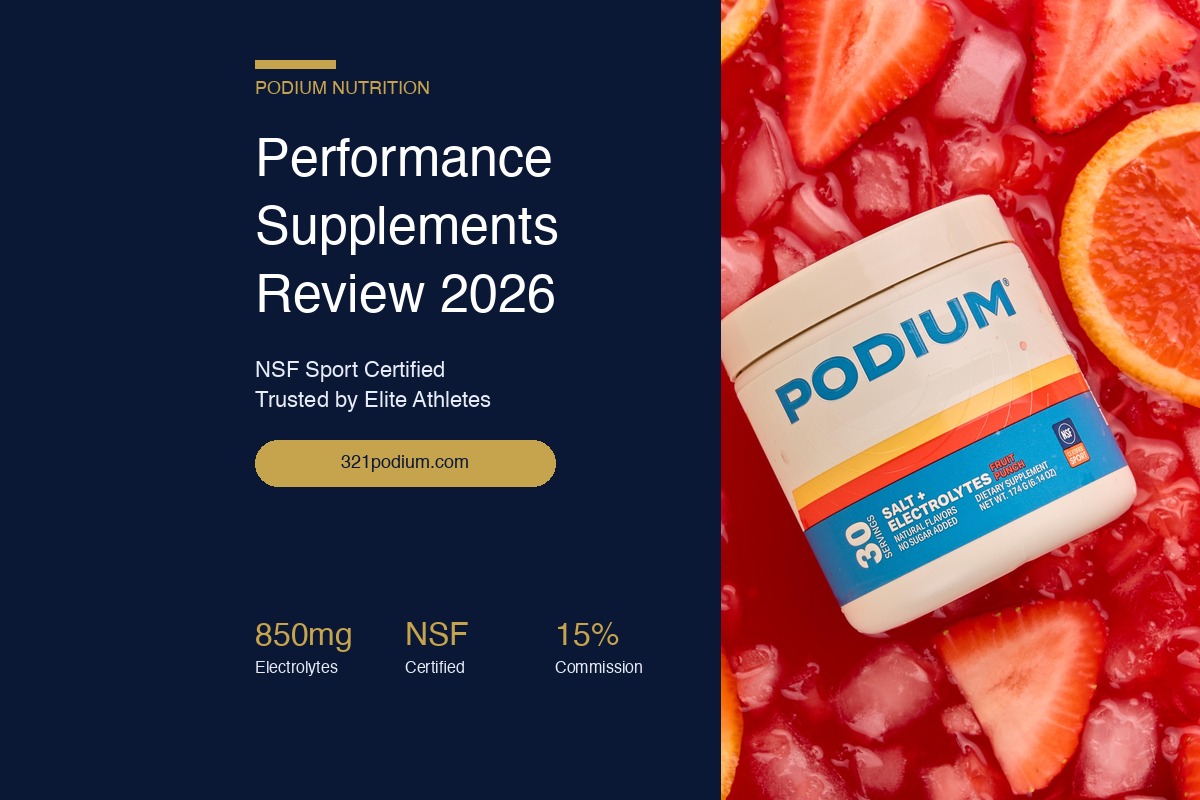
Among supplement brands that have built their identity around NSF certified sports supplements, PODIUM Nutrition is one of the most consistent examples. Their SALT+ Electrolytes, FUSE 2025 pre-workout, and creatine all carry NSF Sport certification – meaning the certification extends across their product range rather than applying to a single hero product as a marketing badge.
The athlete relationships PODIUM has built – NFL, MLB, NHL, NBA, Olympic programs, and CrossFit Games athletes including Jeff Adler and Brooke Wells – reflect what happens when a brand takes certification seriously. Professional team nutritionists and athletic trainers do not put uncertified supplements on approved lists. PODIUM’s presence in those programs is partly a product of the certification.
For the full product lineup with pricing, see our PODIUM Nutrition Review 2026. For an in-depth look at their flagship hydration product, see the PODIUM SALT+ Electrolytes Review.
Practical Steps for Building a Certified Supplement Stack
If you are building or auditing your supplement stack with NSF certification as the standard, here is a practical framework:
Step 1: Identify the essentials
Most research-supported supplement protocols for performance center on: creatine monohydrate, electrolytes/hydration, protein (if dietary intake is insufficient), and optionally a pre-workout if training intensity warrants it.
Step 2: Search the NSF database first
Before buying any supplement in a new category, search nsf.org for certified options in that category. Filter by product type and compare the certified options rather than starting from marketing claims.
Step 3: Compare on formula, not just certification
Among NSF certified sports supplements, compare ingredient doses. For creatine, standard dosing is 3-5g per serving. For electrolytes, look at total electrolyte content and whether the sodium:potassium ratio is appropriate for your training type.
Step 4: Build in subscribe-and-save
Creatine requires sustained daily use (minimum 28 days for saturation without loading) and electrolyte supplementation is most effective when it is consistent. Subscription pricing on certified products makes long-term commitment more economical.
Step 5: Track how your performance responds
Supplements are tools, not magic. Track training output and recovery quality over 4-6 weeks after adding a new certified product to baseline. If performance markers do not improve, the supplement is not working for your physiology regardless of what the label says.
FAQ
Do NSF certified sports supplements cost more than uncertified products?
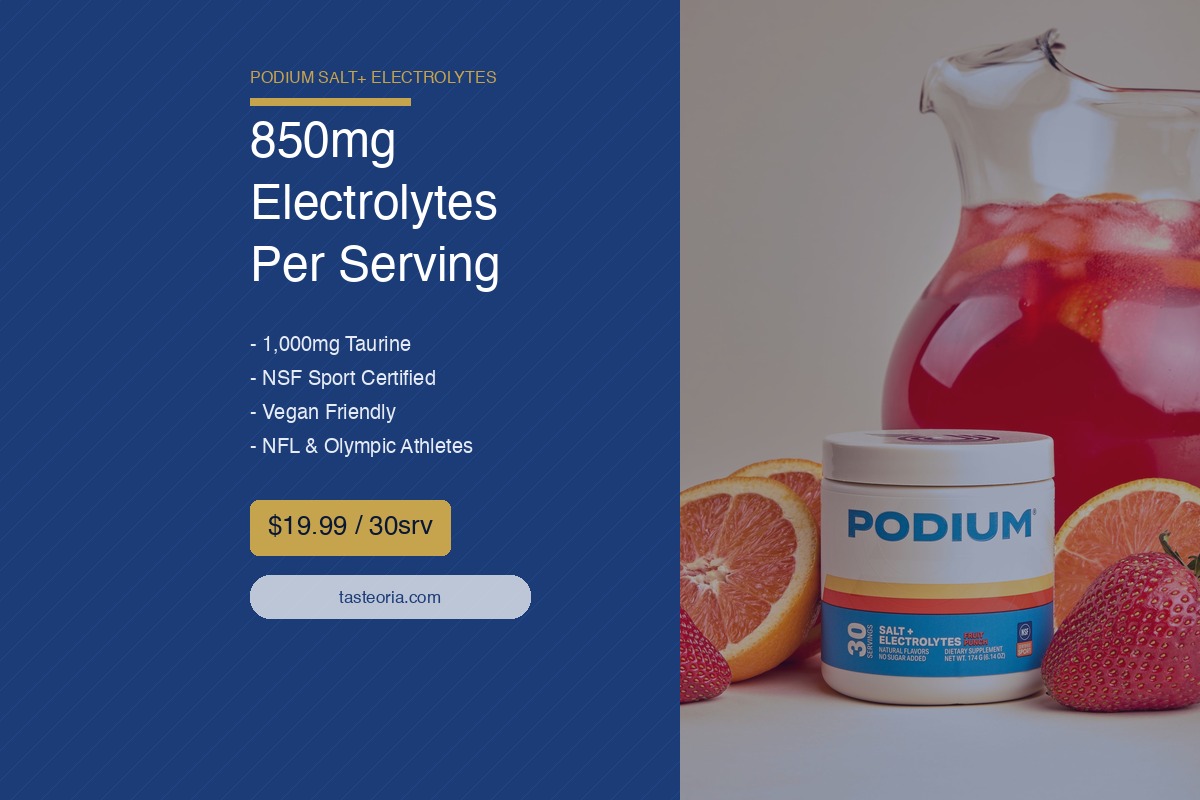
Often yes, but not dramatically. The certification adds testing costs to manufacturing, which is reflected in pricing. However, uncertified products at similar price points often use inferior ingredients. PODIUM SALT+ at $19.99 for 30 servings is competitive with uncertified electrolyte products at the same price.
Can recreational athletes benefit from NSF certified supplements?
Yes. Label accuracy and contaminant testing benefit any consumer, not just tested athletes. Knowing your creatine dose is accurate and your electrolyte powder does not contain heavy metals is valuable regardless of competitive status.
Is NSF Sport certification available for protein powders?
Yes. NSF certifies protein supplements as well. PODIUM Nutrition’s Isolate Whey Protein carries the certification. When evaluating protein powders, NSF certification verifies that the protein content is as claimed – this matters because third-party testing has repeatedly found protein powders that “nitrogen spike” (use cheap amino acids to inflate protein content readings).
How do I verify if a supplement is really NSF certified?
Search the product name and manufacturer in the NSF Certified for Sport product database at nsf.org. If the specific product is not listed there, the certification claim is not verifiable.
Is PODIUM Nutrition available in retail stores?
PODIUM FUSE 2025 pre-workout is available at Target. SALT+ electrolytes are stocked at GNC. The full range is at 321podium.com with bundle pricing and subscribe-and-save options.
The Bottom Line
NSF certified sports supplements represent the clearest available standard for supplement safety and label accuracy in athletic contexts. The certification process – banned substance screening, label verification, facility audit, and annual renewal – is meaningful accountability that voluntary “third-party tested” claims rarely match.
For competitive athletes in tested sports, certified supplements are a risk management requirement. For everyone else, they are a quality floor that cuts through the noise in a market where unverified health claims are the norm.
PODIUM Nutrition has built a brand on this standard, and it shows in where their products end up: NFL and MLB training rooms, Olympic programs, and on the shelves of athletes who need to know exactly what they are putting in their bodies.