Snacking on a carnivore or ancestral diet sounds simple until you are standing in a gas station at 2pm needing something to eat. The beef jerky wall looks promising until you flip it over and find sugar, maltodextrin, soy sauce, and “natural flavors” taking up more space on the label than the actual beef. The protein bars are obviously out. The cheese sticks might work, but you have to check for starches and added gums. The nuts are not carnivore. The trail mix is not carnivore. You leave with nothing or you compromise.
This guide exists so you do not have to make that calculation from scratch every time. It covers what to look for in a carnivore snack, what to avoid and why, which formats work best for different situations, and which brands in 2026 are actually building products that meet the standard — specifically the two-ingredient benchmark that defines the best products in the category.
What Makes a Snack Actually Carnivore?
The carnivore diet, in its most common application, restricts food to animal products only: meat, fish, eggs, and some dairy depending on the individual’s approach. Snacking within that framework means finding portable, shelf-stable animal-product foods that do not contain plant-based fillers, sugars, seed oils, or processed additives.
The spectrum runs from strict to flexible:
Strict carnivore (zero-carb): Meat and salt only. No spices, no sauces, no sweeteners of any kind. Products that meet this standard have two ingredients: meat + salt. Full stop.
Standard carnivore: Meat, salt, and limited spices. Some buyers include small amounts of herbs or garlic. The key exclusions remain: no sugar, no soy, no seed oils, no artificial preservatives, no plant-based fillers.
Ancestral/primal approach: Prioritizes animal products but may include raw honey, coconut aminos, or fermented foods in small quantities. Excludes refined sugars, seed oils, ultra-processed ingredients.
Most carnivore snack buyers fall somewhere in the standard-to-ancestral range when it comes to packaged snacks. The strict zero-carb adherents typically stick to home-prepared meat, hard-boiled eggs, or fresh cheese — not packaged goods.
Knowing where you fall on that spectrum tells you which products actually work for you.
The Golden Rule: 2 Ingredients or Fewer
The most reliable heuristic for evaluating any carnivore snack is the ingredient count. Products with two ingredients — meat and salt — are the benchmark. They tell you immediately that no processing shortcuts, flavor masking, or filler addition happened between the farm and the package.
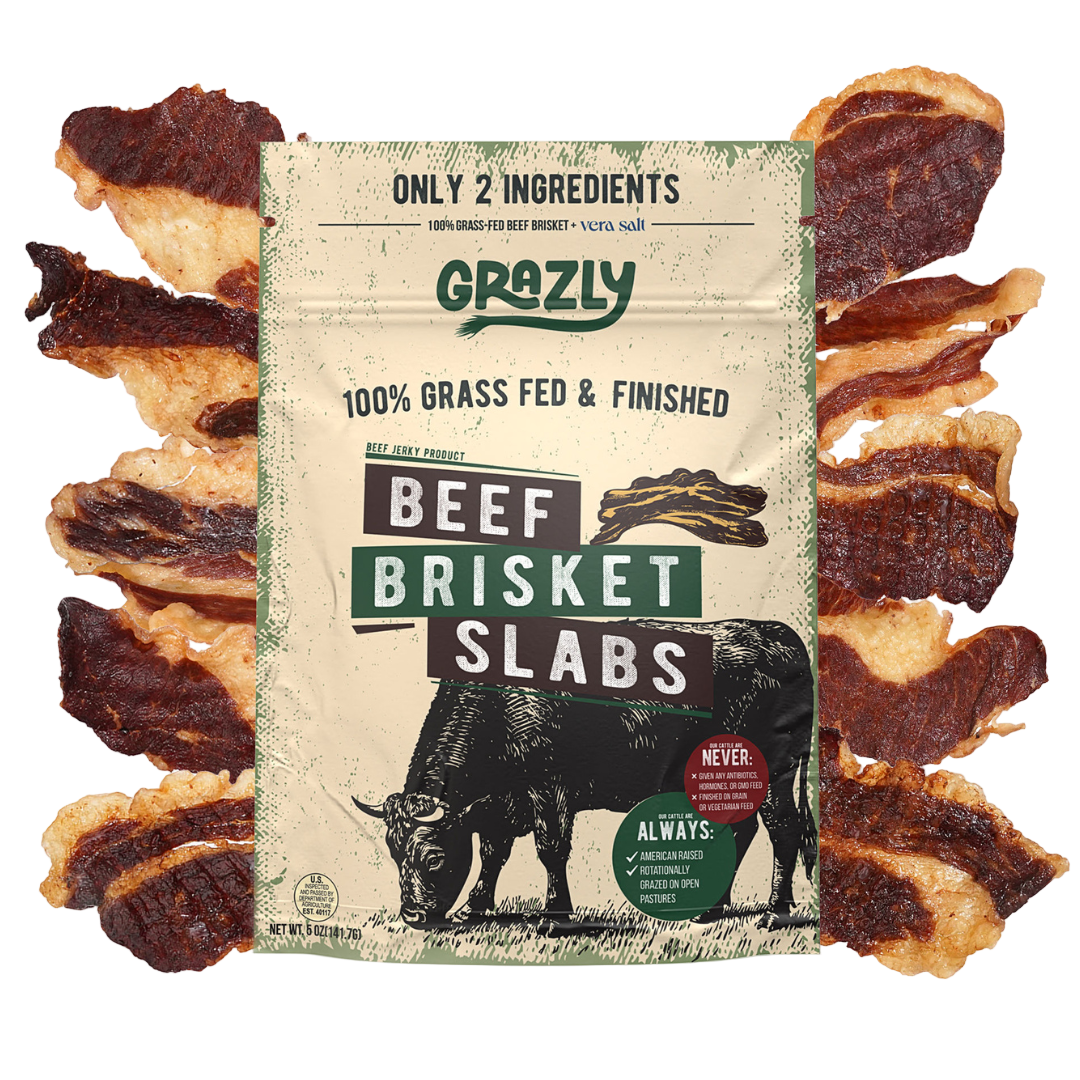
The leading example in 2026 is Grazly Beef Brisket Slabs: 100% grass-fed brisket + microplastic-free sea salt. That is it. The beef is grass-fed and grass-finished from regenerative US and Canadian ranches; the salt is specifically sourced to be microplastic-free. At $34.00 per package with 1,299+ reviews at 4.8 stars, they are the most reviewed and highest-rated product at this ingredient standard in the brisket cut category.
What does a two-ingredient product tell you about what is NOT in it?
- No sugar or sweeteners (no hidden carbohydrates)
- No soy sauce (no wheat, no gluten)
- No seed oils (no canola, sunflower, safflower, or vegetable oil added)
- No artificial preservatives (no sodium nitrite or nitrate)
- No artificial flavors or “natural flavor” ambiguity
- No starch or filler for texture
That absence is not a marketing position — it is the literal result of having only two things on the label.
Grazly Beef Brisket Slabs: the 2-ingredient benchmark, grass-fed & finished
Reading Labels: 6 Things to Look For (and Avoid)
Even with the two-ingredient rule as a guide, you will encounter products that seem clean at first glance but carry red flags. Here is what to check on any carnivore snack label:
1. Sugar by any name. Brown sugar, cane sugar, honey (unless raw), corn syrup, maltodextrin, dextrose — any of these on a beef jerky or meat snack label means hidden carbohydrates. Some brands use multiple small-quantity sweeteners to keep each one off the top of the ingredient list while the cumulative sugar content remains meaningful.
2. Soy sauce or “soy protein.” Soy sauce contains wheat, which puts it outside both carnivore and gluten-free standards. Soy protein isolate is a highly processed plant protein that has no place in an animal-product snack — its presence usually indicates that the meat content is lower than it should be and filler has been added.
3. Seed oils. Canola oil, sunflower oil, safflower oil, cottonseed oil, and generic “vegetable oil” are all seed oils. Their presence in a meat snack is unusual but not unknown — they can appear in seasoning blends or as coating agents. These are not ancestral fats and do not belong in a carnivore snack.
4. “Natural flavors.” This ingredient category is legal shorthand for a large range of flavor compounds that can be derived from plant or animal sources and processed to various degrees. It is not inherently dangerous, but it is opaque — and in a product claiming a clean label, “natural flavors” breaks the transparency that makes a short ingredient list meaningful.
5. Carrageenan, gums, or starches. These are texture and moisture-retention agents. They have no business in a meat product with a legitimate ingredient list. Their presence usually indicates that the meat has been processed in a way that compromised its natural texture, requiring repair.
6. Sourcing claims you can verify. “Grass-fed” without “grass-finished” means the cattle may have spent their final fattening months on grain. “Natural” on a meat label is a USDA term meaning minimally processed and no artificial additives — it says nothing about farming practices. “Regeneratively raised” is not a standardized term, so look for specifics: what ranches, what practices, what third-party oversight.
Snack Formats That Work for Carnivore
Brisket and whole-cut dried beef: The highest-fat format available in the dried meat category. Brisket retains its marbling through the drying process, making slabs more satiating per piece than lean jerky. Best for at-home snacking or situations where you have a moment to eat.
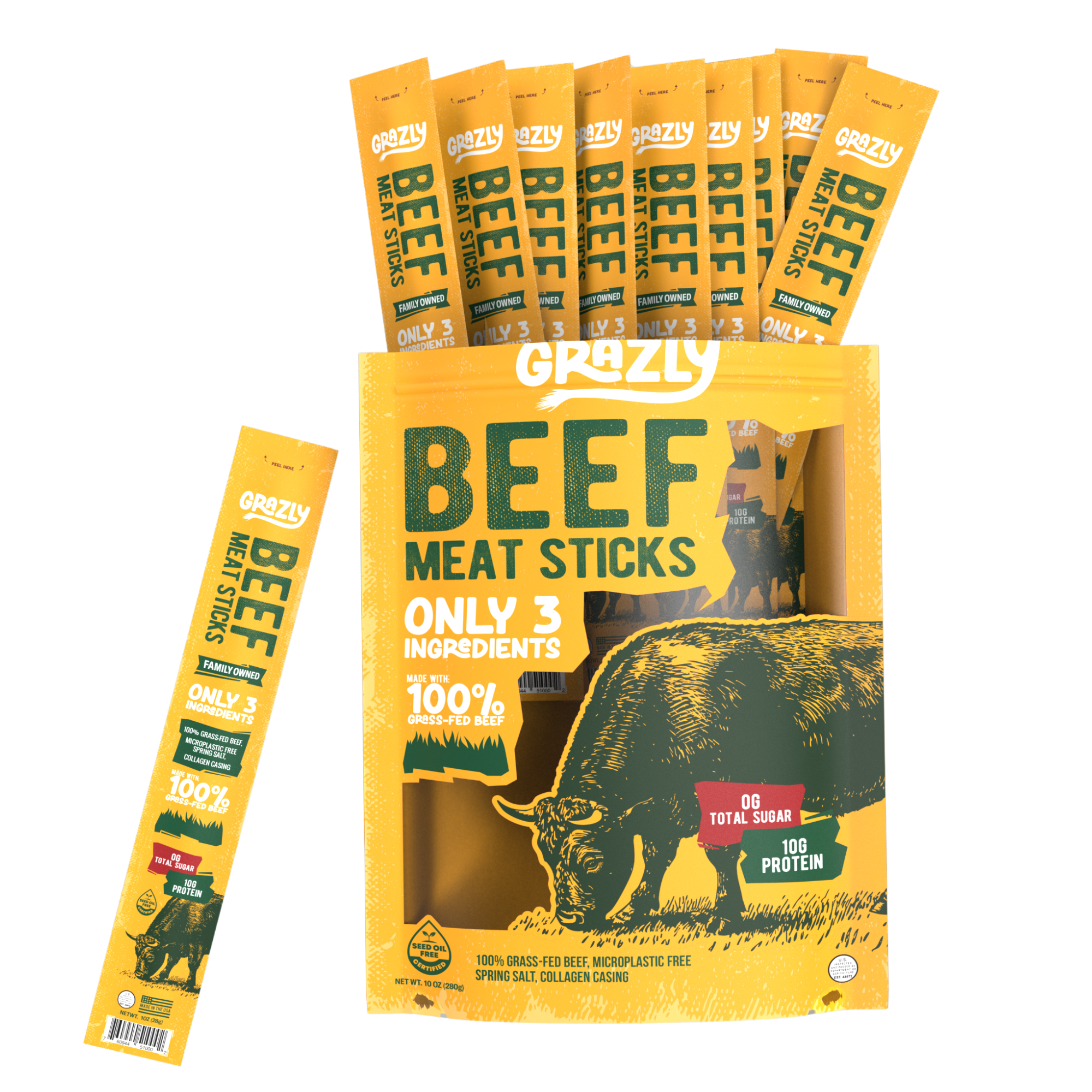
Meat sticks: More portable than slabs, easier to carry, portion-controlled. The format most people are familiar with from gas stations, but the quality spectrum is enormous. Grazly’s Plain Beef Meat Sticks ($38.00, 4.9 stars) are the reference product at the clean-ingredient standard in stick format — grass-fed beef and sea salt in a portable form.
Beef jerky (lean cut): Lower fat, higher protein per ounce. Works well for people who want a lighter snack or who find the fatty brisket format too rich. The caveat: lean jerky has less inherent flavor than fatty cuts, which is why most commercial jerky relies on sugar and soy sauce to compensate. A clean lean jerky needs high-quality beef to taste good without additives.
Organ meat crisps: The most nutrient-dense format per ounce. Liver, heart, and kidney contain vitamins and minerals at concentrations that muscle meat cannot match. Grazly’s Bison Liver Crisps ($19.00) are the accessible entry point — described as crispy, neutral, light, and savory rather than the aggressive flavor of fresh liver. Liver crisps from grass-fed animals provide folate, selenium, and vitamin A (retinol) in a stable, shelf-safe format.
Hard cheese: For carnivore approaches that include dairy, aged hard cheeses (parmesan, aged cheddar, manchego) are naturally low in lactose due to the fermentation process and are shelf-stable for reasonable periods. Check for added starch (some shredded cheeses add cellulose to prevent clumping) and stick to plain blocks or rounds.
Hard-boiled eggs: Not packaged, but the most complete whole-food carnivore snack. Complete amino acid profile, naturally occurring fat and cholesterol, zero processing. The practical downside is refrigeration and the need to prepare them in advance.
Best Ready-to-Eat Carnivore Snacks in 2026
The packaged carnivore snack market has matured significantly since 2020. The following brands and products meet the standard as of mid-2026, with notes on where each fits:
Grazly Beef Brisket Slabs ($34.00) — Best overall for the ancestral fat-forward approach. Two ingredients, grass-finished, brisket cut for maximum richness. 1,299+ reviews at 4.8 stars. The benchmark product in the category.
Grazly Plain Beef Meat Sticks ($38.00) — Best portable stick format at the 2-ingredient standard. Grass-finished, lean-to-moderate fat profile, easy carry. 4.9 stars across 153+ reviews.
Grazly Bison Liver Crisps ($19.00) — Best organ meat option for nutrient density without the challenging flavor of fresh liver. Crispy, neutral profile makes these accessible for people building toward organ meat consumption. Most affordable product in the Grazly range.
Chomps Meat Sticks — A strong competitor in the stick category, typically ~$25–$30 for a multi-pack. Grass-finished beef, no added sugar or soy, clean label. Leaner than Grazly’s brisket product, which suits buyers who prioritize protein density over fat.
Paleovalley Beef Sticks — Grass-finished with fermented ingredients as natural preservatives. Good flavor, clean label, competitive pricing. The fermentation process is somewhat unusual in the category and results in a slightly tangy flavor that not everyone prefers.
For buyers who want to anchor their snack rotation around a single brand that covers multiple formats — slabs, sticks, organ meats — Grazly is the most comprehensive clean option available at this ingredient standard. Their full lineup is available here.
Snacking Strategy: How to Make It Practical
The biggest failure mode in carnivore snacking is being unprepared. When you are hungry and convenient food is available, you make compromises. A few practical systems that work:
Keep a rotation, not a single product. If you are eating clean meat snacks multiple times per week, variety prevents palate fatigue. A combination of brisket slabs (fatty, rich), meat sticks (portable, lighter), and liver crisps (nutrient density) covers different situations and different nutritional profiles.
Buy in bulk where possible. The unit price on any clean meat snack drops significantly with bundle purchases. Grazly offers Brisket Slab Bundles and combination packs. Buying for 2–4 weeks at a time reduces the per-unit cost and ensures you never run out.
Stage snacks for your highest-risk moments. If your office vending machine is a temptation, keep meat sticks in your desk. If long drives are your danger zone, pack slabs in a cooler bag. The goal is to make the clean option the path of least resistance.
Do not confuse protein bars with carnivore snacks. Even “high-protein” bars marketed toward low-carb dieters typically contain plant-based protein isolates, sweeteners, and seed oils. They are not carnivore, and they are not a suitable substitute for actual animal-product snacks.
The Organ Meat Gap Most People Ignore
If you are eating carnivore for health reasons — nutrient density, elimination of anti-nutrients, ancestral alignment — muscle meat alone does not complete the picture. Traditional cultures that ate nose-to-tail diets consumed organ meats regularly. Liver in particular was prized above muscle meat in many cultures precisely because of its nutritional concentration.
Modern carnivore snacking has largely replicated the muscle meat portion of that diet in convenient form. The organ meat component is harder to find in packaged, shelf-stable form — which is what makes the Bison Liver Crisps category meaningful. At $19.00 for a shelf-stable, accessible-flavor organ product, they represent a practical way to add liver nutrition without having to cook fresh liver, which many buyers find intimidating.
For buyers who are not yet eating liver regularly, crisps are a low-commitment starting point. The flavor profile is significantly more neutral than pan-fried liver, and the format integrates naturally with the rest of a snack-based meat rotation.
Putting It Together
Carnivore snacking in 2026 does not require sophisticated label analysis once you internalize the core rules: two ingredients (meat + salt) is the benchmark; grass-finished matters more than grass-fed alone; fat retention in the cut is a feature, not a defect; and organ meats fill the nutrient-density gap that muscle meat leaves open.
The practical product list is not long. Grazly’s range — Beef Brisket Slabs, Plain Beef Meat Sticks, and Bison Liver Crisps — covers the main categories at the highest ingredient standard currently available in the market. Starting with the Brisket Slabs gives you the flagship product at the center of that standard, with 1,299+ verified buyers confirming it delivers on the promise.
For a detailed look at the flagship product, see the Grazly Beef Brisket Slabs review. For a brand-level breakdown of the full Grazly lineup including pricing and competitive comparison, the Grazly brand review has everything you need.