The protein bar market is enormous, overcrowded, and — if you’re paying attention to what’s actually in most bars — deeply misleading. In 2026, “ancestral protein bars” have emerged as a meaningful subcategory: a small but growing group of products built around the idea that human nutrition should look more like what people ate before industrialization transformed the food supply. Grass-fed animal proteins. Traditional fats. Real sweeteners. No seed oils, no synthetic additives, no ingredient lists that read like chemistry textbooks.
If you’re new to the ancestral eating movement or simply looking for the best protein bars that actually contain clean ingredients, this guide covers what makes a bar “ancestral,” why it matters nutritionally, how to evaluate options in this space, and which product earns the top spot in 2026.
What Makes a Bar “Ancestral” (And Why It Matters)
The term “ancestral” in food and nutrition refers broadly to eating patterns that mirror what pre-industrial, pre-agricultural, or pre-processed-food-era humans consumed. In the context of protein bars, an ancestral approach means:
Animal-sourced protein, not plant isolates
Conventional protein bars typically rely on whey isolate, soy protein, pea protein, or rice protein. These are processed extracts, often produced through industrial fractionation, that deliver amino acids efficiently but miss the full nutritional context of whole-animal eating. Ancestral bars prioritize collagen peptides, whole-food whey, and in some cases egg white or other animal-derived proteins.
Traditional fats over seed oils
The shift from traditional cooking fats (tallow, lard, butter) to seed oils (canola, soybean, sunflower, safflower) happened largely in the 20th century, driven by industrial agriculture economics rather than nutritional evidence. Ancestral bars specifically exclude seed oils and use fats with historical precedent: beef tallow, coconut, butter.
Natural sweeteners over synthetic alternatives
Raw honey, dates, and maple syrup are the ancestral sweetener tier. Sucralose, acesulfame-K, erythritol, and similar synthetic or industrial sweeteners are excluded from genuinely ancestral products.
Short, readable ingredient lists
Perhaps the simplest definition: if you couldn’t produce the ingredient in a home kitchen or a small farm, it probably doesn’t belong in an ancestral bar. “Natural flavors,” “modified starch,” and “maltodextrin” are flag terms.
Why does this matter? The ancestral eating movement is grounded in the observation that rates of chronic disease, metabolic dysfunction, and obesity accelerated dramatically alongside the industrialization of the food supply. While correlation is not causation, there’s growing scientific interest in ultra-processed food as an independent variable in health outcomes. Choosing products with whole, recognizable ingredients is a practical way to reduce ultra-processed food load without entirely abandoning the convenience of packaged snacks.
The Nutritional Case for Animal-Source Protein Blends
Most mainstream protein bars are built around a single protein source. What makes the best ancestral bars nutritionally distinctive is the combination of multiple animal-sourced proteins, each contributing different amino acid profiles and functional benefits:
Collagen Peptides
Collagen is the structural protein of connective tissue — tendons, ligaments, cartilage, skin, gut lining, bones. It’s the most abundant protein in the body and in whole-animal diets, but it’s nearly absent from modern eating patterns that center on muscle meat. Collagen is rich in glycine, proline, and hydroxyproline, none of which are found in significant amounts in soy, pea, or conventional whey protein. Regular collagen consumption is associated with support for joint health, skin elasticity, gut barrier function, and sleep quality (glycine is a calming neurotransmitter precursor).
Whey Protein Concentrate
Whey concentrate differs from whey isolate in a key way: concentrate retains the full range of naturally occurring milk proteins, including immunoglobulins, lactoferrin, and growth factors that isolate processing removes. For muscle protein synthesis, whey is still the gold standard protein source — leucine content is high, and absorption is fast relative to other protein types.
Grass-Fed Beef Tallow
Tallow is not a protein source — it’s a fat. But its inclusion in the best ancestral protein bars reflects the whole-food philosophy: traditional eating integrated fats and proteins together, and isolating one at the expense of the other creates an incomplete nutritional picture. Grass-fed tallow provides a favorable saturated and monounsaturated fat ratio, plus fat-soluble vitamins (A, D, E, K2) that require dietary fat to absorb properly. Critically, it replaces seed oils — the primary fat source in most conventional bars.
The combination of collagen + whey + tallow in a single bar format is uncommon in the packaged food space. It’s a nutritional architecture that would look familiar to anyone eating a traditional whole-animal diet, packaged in a portable modern format.
What to Look for When Buying Ancestral Protein Bars
Before committing to a brand or product, check these five factors:
1. Ingredient list transparency
The shorter and more recognizable the better. Every item should be identifiable: a plant, an animal product, or a minimally processed derivative of one. Flag any appearance of “natural flavors,” “modified” anything, or ingredients that require Wikipedia to understand.
2. Protein source specificity
“Grass-fed” on a label should be verifiable. Look for specific sourcing language — bovine collagen peptides from grass-fed cattle, not just “collagen” of unspecified origin.
3. Fat quality
What fat source is the bar using? If seed oils (canola, sunflower, soybean, safflower) appear in the ingredient list, the bar does not meet ancestral quality standards regardless of other claims.
4. Sweetener type
Ancestral sweeteners: raw honey, dates, coconut sugar, maple syrup. Non-ancestral: sucralose, aspartame, acesulfame-K, erythritol, xylitol, allulose (though some ancestral eaters accept the latter two), sugar alcohols.
5. Certification and third-party verification
Non-GMO certification is a useful baseline. Gluten-free certification matters for those with sensitivity. A complete absence of soy is important for people with soy allergies or those following grain/legume-free protocols.
Our Top Pick: Prima Cookie Dough
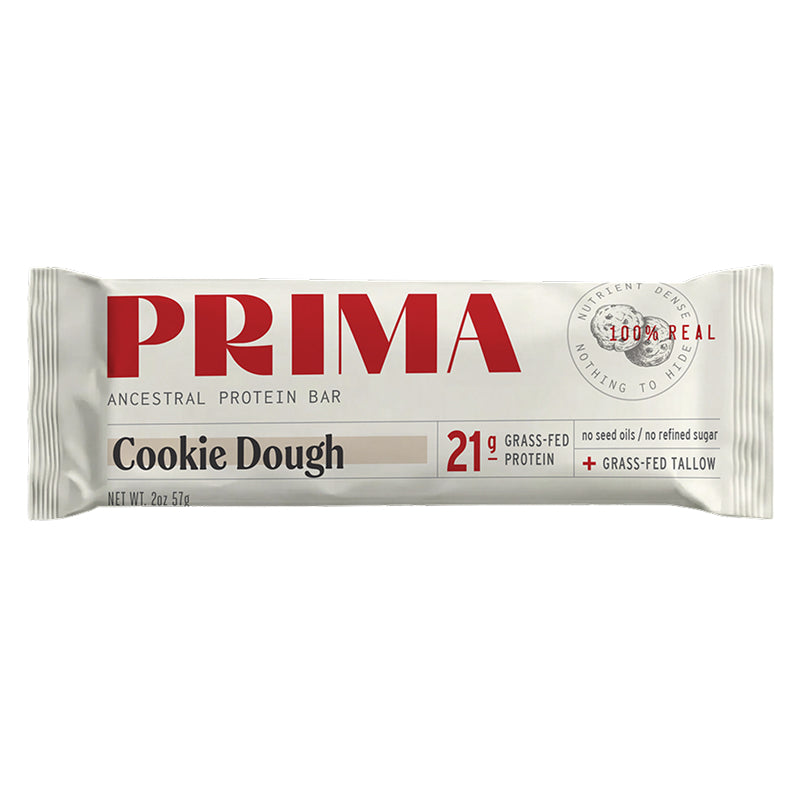
After surveying the ancestral protein bar space in 2026, one product consistently emerges at the top: the Prima Cookie Dough Ancestral Protein Bar.
Why Prima leads the category:
The Prima Cookie Dough bar checks every box defined above. The ingredient list is eight items long: PRIMA Protein Blend (Grass-fed Bovine Collagen Peptides, Grass-fed Whey Protein Concentrate), Organic Raw Honey, Grass-fed Beef Tallow, Organic Coconut, Organic Cacao Nibs, Organic Coffee Extract, Egg Yolk, Organic Vanilla Extract, Salt.
No seed oils. No natural flavors. No synthetic sweeteners. No soy. No gluten. Non-GMO. Every protein and fat source is explicitly grass-fed.
Nutritional profile per bar (57g):
– Calories: 240
– Protein: 21g (grass-fed collagen + whey blend)
– Total Fat: 12g (from grass-fed tallow and coconut)
– Total Carbs: 14g (from raw honey and coconut)
– Added Sugar: 11g (raw honey only)
At $27.93 per pack — approximately $3.99 per bar — Prima sits at the premium end of the market. But premium is relative: compared to buying grass-fed collagen, grass-fed whey, and clean fat as separate supplements, the bar format is an efficient and convenient delivery mechanism.
The flavor range:
Prima offers five flavors, all at the same price point and nutritional profile:
– Cookie Dough (flagship)
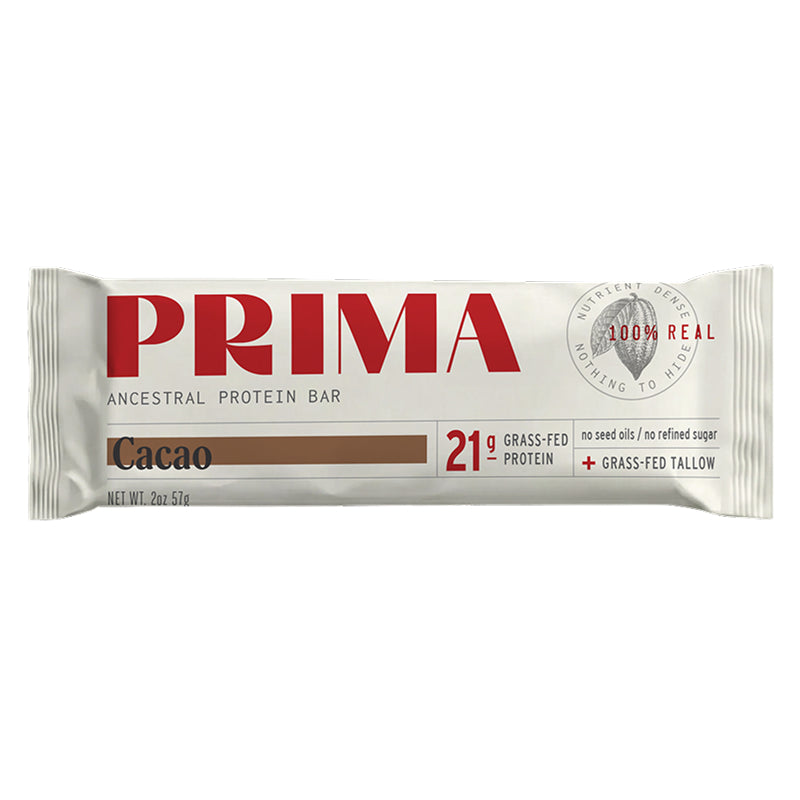
– Cacao
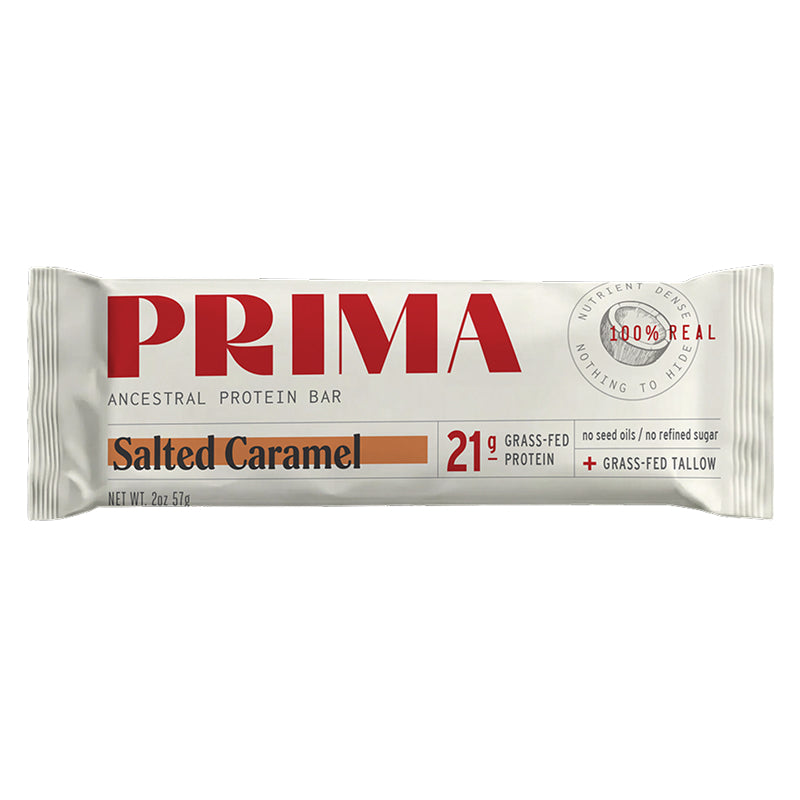
– Salted Caramel
– Mocha
– Mint Chip (newest)
The Cookie Dough bar is the category standard-bearer because it demonstrates the full range of Prima’s ingredient approach: vanilla, cacao nibs, coffee extract, and coconut layered over the collagen-whey base, sweetened with raw honey. The Salted Caramel and Mocha are strong alternatives for those who want a single dominant flavor note.
Prima is also transparent about what it’s fighting against — their brand is explicitly built around “joining the fight against fake food,” which aligns directly with the ancestral eating philosophy.
Shop the Prima ancestral protein bar range
How to Incorporate Ancestral Protein Bars Into Your Diet
Protein bars — even the best ones — are tools of convenience, not replacements for whole meals. Here’s how to use ancestral bars effectively:
Post-workout recovery
The collagen + whey combination in Prima bars covers both fast-absorbing protein (whey’s BCAAs trigger muscle protein synthesis) and slow-absorbing structural protein (collagen supports the connective tissues stressed during training). This dual-action makes ancestral bars particularly well-suited for post-workout use compared to single-source protein products.
Mid-morning or afternoon snack
The fat content (12g from tallow and coconut) provides satiety that pure protein bars lack. Combined with 21g protein and moderate carbs from raw honey, a Prima bar is better at maintaining energy between meals than low-fat, high-protein alternatives.
Travel and on-the-go eating
The whole point of a packaged bar is portability. When clean food options aren’t available — at airports, during long drives, between meetings — having an ancestral bar on hand prevents defaulting to ultra-processed alternatives.
Supplement to a collagen protocol
Many people take collagen supplements daily for joint support, skin health, or gut healing. A Prima bar can serve as a collagen delivery mechanism with the added benefit of satiety from protein and fat — more functional than a collagen drink or capsule.
The Bottom Line on Ancestral Protein Bars in 2026
The ancestral protein bar category is still small relative to conventional protein bars, but it’s growing for good reasons. Consumers are reading labels more carefully, scrutinizing “natural flavors,” and questioning whether the seed oils and synthetic sweeteners in most bars are serving their health goals.
The best ancestral protein bars in 2026 — exemplified by the Prima lineup — offer an alternative: short ingredient lists, grass-fed animal proteins, traditional fats, and real sweeteners. They taste different from conventional bars because they’re built differently. And for the consumers they’re designed for, that difference is the whole point.
If you’re ready to try the category’s leading product, the Prima Cookie Dough Ancestral Protein Bar is the place to start. The Variety Pack at $27.93 lets you sample the full range before committing to a single flavor — the most sensible entry point for first-time Prima buyers.
Real food. No excuses.
Related reads: Prima Cookie Dough Bar Review: Best Ancestral Protein Bar? | Prima Protein Bar Review 2026: Does the Ancestral Formula Deliver?